


With the gradual introduction of the e-invoicing obligation in domestic B2B business, many companies are currently dealing with formats, transmission channels and deadlines. In the beverage industry – and in all industries with reusable containers – there is an additional question that rarely appears in general guidelines, but regularly causes surprises in projects: What happens to an invoice if the return of empties exceeds the value of the delivery?
Table of Contents
The Problem: One Document, Two Directions
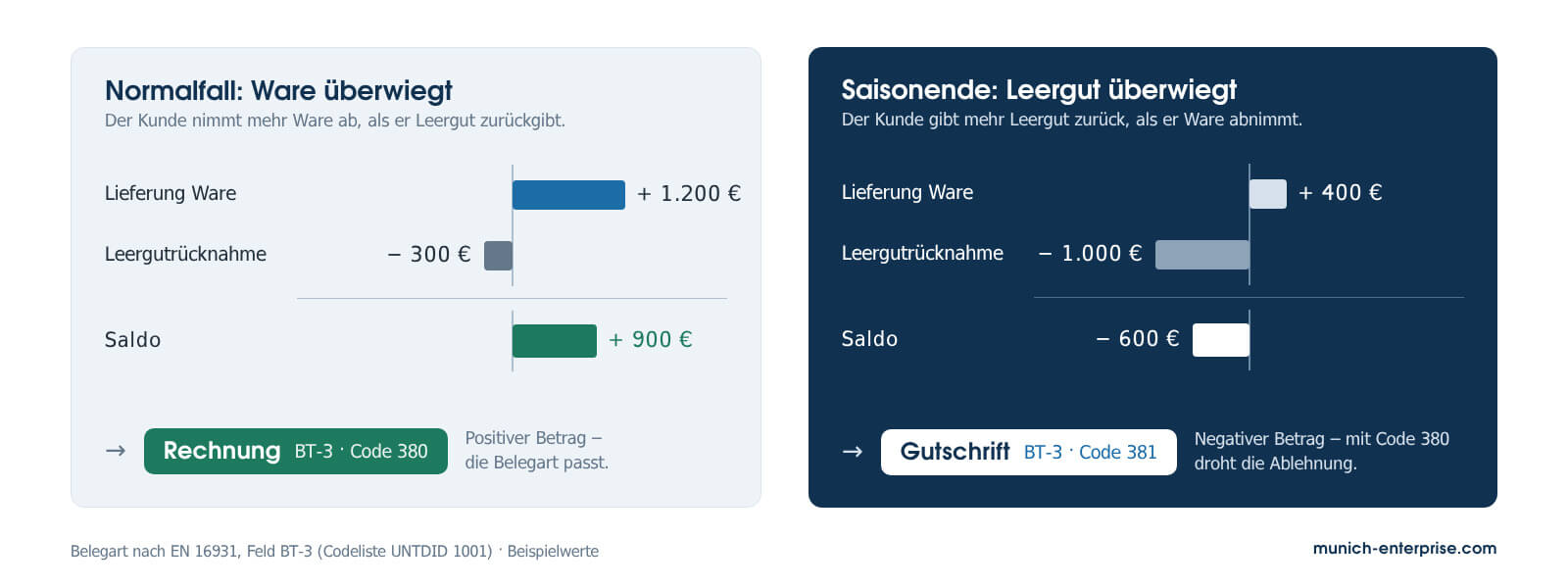
In many SAP systems in the beverage industry, delivery and empties return are settled in a common billing document. The customer receives new goods, returns empties at the same time, and both appear on one receipt. As long as the delivered goods predominate, a normal invoice with a positive total amount is created.
The situation is different if a customer returns more empties than he buys goods in a period – for example, at the end of the season, in the event of assortment changes or when returning stock. Then the balance is negative. Economically, the invoice has become a credit note, but technically it remains the same billing document.
Why this has rarely been noticed so far
On paper or as a PDF, this case was unproblematic. A human reads the receipt, sees the negative amount and posts it accordingly. The document type was never part of a machine check.
Structured e-invoice formats such as XRechnung and ZUGFeRD work differently. The underlying semantic data model of the EN 16931 standard contains the BT-3 (“Invoice type code”) field, an explicit indication of the document type, and the receiving systems are increasingly processing the data automatically. A document that is marked as an invoice but shows a negative total amount can lead to queries, rejections or incorrect postings, depending on the recipient system. What was previously a marginal case is now becoming a question of process quality.

Not just a topic for the beverage industry
The beverage industry is the best-known example, but by no means the only one. The same effect can occur wherever reusable containers, deposits or rental containers are settled with the delivery of goods. Typical examples are dairies with returnable bottles and crates, suppliers of technical gases with deposit or rental bottles, the chemical industry with kegs and IBC containers, the food and fresh food wholesale trade with reusable crates and pallets, cable manufacturers and building materials dealers with cable drums and pallets, and suppliers who bill load carriers via empties accounts.
The pattern is also used wherever deliveries and returns come together in one receipt – for example, in the case of returns in retail or returns in press sales. Here, too, a document that starts as an invoice can show a negative balance at the end.
Document types in e-invoices – and a clarification of terms
The document type is specified in BT-3 using a code from the UNTDID 1001 code list. The following codes are particularly relevant to the topic of this article:
| Code | Label | Typical Usage |
| 380 | Commercial invoice | Standard invoice for deliveries and services |
| 381 | Credit note | Receipt with a reduction in favor of the recipient, such as a return of empties with a negative balance |
| 384 | Corrected invoice | Correction of a previously issued invoice |
| 389 | Self-billed invoice | Billing by the recipient of the service (credit note procedure) |
selection. The applicable code lists and specifications of the format used are decisive.
The table shows why the term “credit note” requires care. In commercial parlance, it usually means a reduction in favor of the customer – this corresponds to code 381. The VAT credit procedure, in which the recipient of the service bills himself, on the other hand, is kept separately (code 389). In this article, we use “credit note” in the commercial sense. How a receipt with a negative balance is to be classified and labeled for tax purposes should be clarified by every company with its tax advice.
Possible solutions in SAP
There is no uniformly correct way – which one is right depends on processes, customer structure and system landscape. Basically, there are three approaches that can also be combined.
Billing Split. Delivery and reverse of empties are already divided into separate documents during invoicing, for example using separate billing types or split criteria in copy control. The delivery of goods is output as an invoice, and the return of empties as a separate document. The advantage lies in clarity: each document has a clear direction. This creates more documents, and customers receive two documents instead of one.
Document type determination by balance. The common document is retained, but the document type of the e-invoice is determined depending on the total amount: positive as invoice (380), negative as credit memo (381). This keeps the number of documents low, but shifts the decision to the expense logic and must be properly coordinated with accounting and dunning. The syntax must be observed: In the UBL format, invoice and credit memo are different document types, in the UN/CEFACT CII format they are essentially differentiated by the code. Depending on the format, the change of document type is therefore more than another value in a field.
Procedural separation. Returns of empties are billed separately from an organizational point of view, for example in separate billing runs or on fixed key dates. This approach requires the fewest system changes, but interferes with familiar processes and must be coordinated with sales and customers.

Why the timing of the decision is important
Anyone who sets up a new SAP system, for example as part of an S/4HANA introduction on a greenfield site, can design the invoicing process from the outset in such a way that clear documents are created. The decision is then part of customizing and hardly causes any additional effort.
In existing systems, the same adaptation is an intervention in ongoing processes – with an impact on evaluations, interfaces and familiar processes. And those who only discover the topic in the test of e-invoicing are under time pressure because the solution lies not in the e-invoicing software, but in invoicing.
Questions that pay off early on
For companies with deposit, empties or reusable processes, it is advisable to clarify a few points before introducing e-invoicing: Are deliveries and empties returned billed in the same document today? Are negative total amounts occurring, and how often? What types of documents do the most important customers expect? And who in the company decides at which level the issue is resolved – invoicing, issue or process?
Result
Deposits and empties are a good example of how e-bills are more than just a new output format. It makes invoicing peculiarities visible that no one has noticed before. If you ask these questions early on, you save yourself correction loops in the test – and your customers unnecessary queries.

