


E-invoicing obligation from 2025 – this applies to all domestic companies in the B2B sector. From 01.01.2025, companies must be able to receive e-invoices; classic PDFs are no longer considered electronic invoices within the meaning of the EN 16931 standard.
Transitional periods until 2026 or 2027 apply to issuing (e.g. for companies with a turnover of €800,000 ≤ the previous year). ZUGFeRD (from 2.0.1) and XRechnung are acceptable formats. E-invoicing to private individuals (B2C) will remain voluntary for the time being. Here, IT managers, IT management, accounting, purchasing and sales receive a compact overview with examples, checklists and internal links.
Table of Contents
- What does the e-invoicing obligation mean in concrete terms from 2025?
- Who is affected – and who is exempt?
- Read the e-book on the topic of e-invoicing obligation 2025:
- Formats & Standards: XRechnung, ZUGFeRD & EN 16931
- Timeline & transition periods (2025–2027)
- Practical guide: 6 steps to e-invoicing
- FAQ – Questions about the e-invoicing obligation 2025
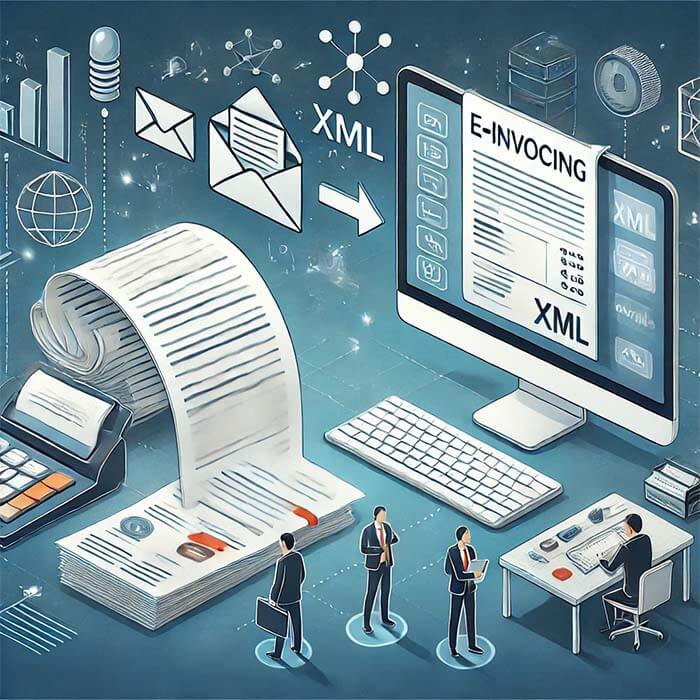
What does the e-invoicing obligation mean in concrete terms from 2025?
Since 01.01.2025, the German VAT Act has only differentiated between e-invoices (structured, machine-readable) and other invoices (paper, unstructured PDF). An e-invoice must enable electronic processing; simple PDFs are no longer enough. All companies must be able to receive – an e-mail inbox is sufficient as a start.
- Applies to: Transactions between domestic entrepreneurs (B2B).
- Does not apply to: consumers (B2C) and many tax-exempt transactions (§ 4 No. 8-29 of the German VAT Act).
- Small-value invoices: up to €250 still possible as other invoices.
E-invoicing solution from munich enterprise software – compatible with XRechnung & ZUGFeRD.
Who is affected – and who is exempt?
All entrepreneurs, including freelancers, are affected. Small businesses are exempt from the obligation to issue, but must be able to receive e-invoices. B2C remains without obligation; E-invoices to private individuals are voluntary. Examples:
- Small business owner (example agency): may continue to send PDFs, must be able to receive/archive e-invoices.
- Craft business B2B: Received from 2025 mandatory; It can still be issued as an “other invoice” until the end of 2026 (possibly 2027) – with the consent of the recipient in the case of electronic PDFs.
- Invoice to private customer: paper or PDF still allowed; E-bill voluntary.
Read the e-book on the topic of e-invoicing obligation 2025:
Formats & Standards: XRechnung, ZUGFeRD & EN 16931
Formats according to EN 16931 are permitted, in particular XRechnung and ZUGFeRD from version 2.0.1 (without MINIMUM/BASIC-WL). Existing EDI methods can continue to be used, provided that the data can be extracted in full. Brief overview:
- XRechnung: XML-based; Standard in the public sector (B2G), widely used in B2B.
- ZUGFeRD 2.x: Hybrid (PDF + XML). This is practical if the receipt is also to be readable in a “human” way.
- EDI/EDIFACT: still possible if agreed (full extraction of mandatory information).
Suitable products & integrations from munich enterprise software:
- SAP E-Invoice – Sending Invoices
- MailCenter – central invoice communication
- Outlook Integration – Process Receipts Directly from Outlook
- Monitoring – transparency in the invoice flow
Timeline & transition periods (2025–2027)
The obligation comes gradually:
- From 01.01.2025: All companies must be able to receive e-invoices .
- 2025–2026: For the issuance , companies may optionally use an “other invoice” (paper, PDF with consent).
- Until 31.12.2027: Extended transitional period for exhibitors with previous year’s turnover ≤ €800,000; non-compliant EDI procedures may also continue until then. Only then will it be mandatory for everyone to issue an e-invoice.
Note: PDF is not an e-invoice. Companies should switch to XRechnung/ZUGFeRD in good time and adapt processes (ERP, workflow, archive). IHK overviews confirm the new definitions.
Practical guide: 6 steps to e-invoicing
- Analysis of the current situation: Which systems create/receive invoices (ERP, DMS, E-Mail)?
- Define formats: XRechnung, ZUGFeRD or EDI – depending on the customer/supplier.
- Connect technology: Activate the e-invoice module , test interfaces, routing route ID only for B2G.
- Define processes: Incoming inspection, approval, posting, archiving.
- Inform partners: Agree on an exchange channel (e-mail, portal, API).
- Rollout & Training: departments (purchasing, sales, financial accounting).
Example: A medium-sized manufacturer agrees with suppliers on XRechnung by e-mail. Incoming XML is checked in the approval process , assigned via Outlook integration , sent by invoice dispatch and tracked in monitoring – clear, audit-proof, efficient.

FAQ – Questions about the e-invoicing obligation 2025
A structured electronic invoice in accordance with EN 16931, e.g. XRechnung or ZUGFeRD 2.x. PDFs without a structured XML part are not e-invoices.
Who will have to receive e-invoices from 2025?
All domestic entrepreneurs – regardless of size or industry.
When do I have to issue e-invoices?
In 2025/2026 there are transitional rules; issuing will become completely mandatory after the deadlines have expired (at the latest by the end of 2027 for small exhibitors). Plan the transition now.
Is there a ZUGFeRD obligation?
No. Formats according to EN 16931 are permitted; XRechnung and ZUGFeRD (from 2.0.1) are common.
Does the e-invoicing obligation apply to small businesses?
Small businesses are exempt from the obligation to issue, but must be able to receive e-invoices.
Does the obligation also apply to B2C (private customers)?
No. There is no obligation for private individuals; E-invoices are optional there.

